What I wish someone told me when I started my career
- Sarah Wells
- May 4
- 3 min read

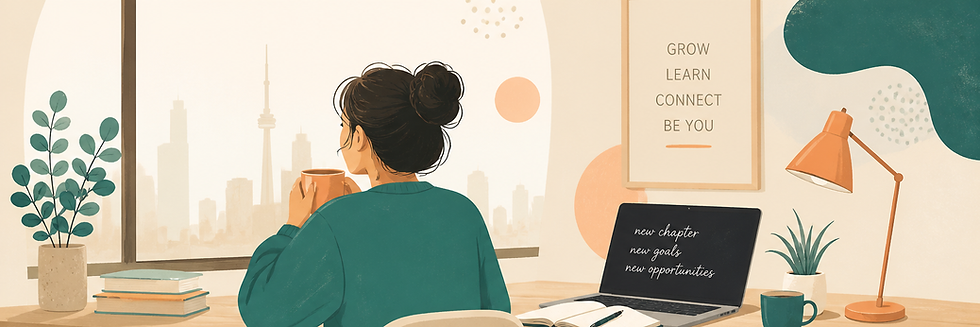
As college and university semesters wrap up and we head into convocation season, a new wave of graduates is stepping into something entirely new.
Careers. Independence. “Adulting” in a way they’ve never experienced before.
And if I’m being honest, it can feel exciting and overwhelming at the same time.
I remember graduating and thinking I would land a job no problem.
I was very wrong.
After about a year of applying with very little traction, I went back to college for a post-graduate certificate. I worked hard, graduated at the top of my class, and then walked straight into a recession where communications and marketing jobs were disappearing.
I was suddenly competing with experienced professionals who were just trying to support their families. For the next few years, I took freelance work where I could, building experience piece by piece, until eventually landing a short contract that led to my first real career opportunity.
The landscape looks different now. There are more roles, more specialization, and more opportunity. But in many ways, it is still just as competitive and just as uncertain.
Recently, a new grad reached out and asked if I had any advice as they started their career.
So here is what I told them.
1. You may be done school, but don’t stop learning
Communications, marketing, and social media are constantly evolving.
Most organizations are not hiring large teams. They are hiring one person and expecting them to do a bit of everything (which isn't right, but is what happens). That means the more you understand, the more valuable you become.
Content. Social, both organic and paid.
Video.
Analytics.
Design.
AI.
You do not need to be an expert in everything, but you do need to be curious and willing to learn.
Not sure where to start? Look at job postings for roles you are interested in. Identify the gaps and start there.
2. Build a portfolio and keep building it
When I started applying, a portfolio was a bonus. Now it is expected.
Your portfolio does not just show what you have done. It shows how you think.
Use tools like Canva or Adobe, or build your own site (like this one).
Introduce yourself. Share your work. Start a blog.
Show people how you approach problems, how you think about strategy, and how you communicate ideas.
That is what sets you apart.
3. Use AI to support your process, not replace it
Job hunting is exhausting. AI can help make it more manageable.
Use it to analyze job descriptions, tailor your resume, and prepare for interviews (this may be the biggest hack that not many people seem to be thinking about yet).
But do not rely on it to do the thinking for you. The goal is not to sound perfect.The goal is to sound like you, at your best.
4. Build relationships, not just applications
One of the biggest turning points in my career came from a connection.
I had been writing blogs and sharing my thoughts online. I'd managed to connect with an alum from my university and offered her support when her sister was looking for a post-grad similar to the one I took.
Because of what I'd been writing and that connection, when a role opened up at her organization, she reached out and encouraged me to apply.
I had not seen the posting anywhere else.
That opportunity changed everything.
Your next role may not come from a job board. It may come from a conversation, a connection, or someone remembering your name.
So contribute. Be visible. Reach out.
Just like the new grad who reached out to me. That matters more than you think.

5. Stay positive, even when it’s hard
Job searching can be frustrating. Rejection is part of the process.
But how you show up matters.
I remember meeting someone early in my career who was incredibly talented, but all they talked about was how unfair the process was and how they were better than the people getting hired.
And I remember thinking, if this is the energy you bring into a conversation, that might be the reason you are not landing the role.
Your attitude will not replace your skills, but it will shape how people experience you.
Stay grounded. Stay positive. Keep showing up.
Final thought for those starting their career
Starting your career is not a straight line.
It is messy. It is uncertain. It is full of starts, stops, and unexpected turns.
But every step is building something, even when it does not feel like it.
Your first job won’t define your career, but how you approach it will.
If you stay curious, stay connected, and stay open to learning, you will find your way forward.


Comments