The next digital transformation challenge for higher ed: Knowledge
- Sarah Wells
- Jun 17
- 8 min read


Institutions have spent years building content ecosystems. The next challenge may be building knowledge ecosystems.
The next digital transformation challenge for higher ed: KnowledgeThis article started with two completely separate conversations.
The first was a discussion from Nathan Monk at Prospective Plus about social media restrictions and what they might mean for student recruitment and discovery.
The second was a post from John R. and the OnDeck team exploring changing search behaviours, Google's evolving role, and tools like NotebookLM.
Individually, both conversations were interesting.
Together, they sent me down a completely different line of thinking.
Not about social media.
Not about AI.
Not even about search.
About knowledge.
More specifically, how institutions manage, govern and distribute knowledge in a world where people increasingly expect answers instead of information.
Students are asking questions instead of searching for answers
For most of my career, the challenge seemed relatively straightforward.
How do we help students find information?
We built websites.
We created viewbooks.
We developed FAQs.
We launched search tools.
We optimized navigation.
We invested in SEO.
We expanded social media.
And for a long time, those investments made sense. If students had a question, our job was to make sure the answer existed and could be found.
The challenge was access.
Today, I'm not sure that's the challenge anymore.
Because increasingly, students aren't asking: "Where can I find the answer?"
They're asking: "Can someone just give me the answer?"
That someone might be, a recruiter, a student ambassador, a chatbot, ChatGPT< Gemini, Claude, a friend, a parent or group chat or something different.
The channel is changing, but the behaviour is remarkably consistent.
Students are becoming more comfortable asking questions than searching for answers.
And honestly, it makes sense.
My six-year-old is growing up in a world where asking a question is often the first step to finding information. He isn't learning how to navigate encyclopedias or library catalogues the way that I did. He's learning that information can be requested, retrieved and presented.
Increasingly, prospective students are developing similar expectations.
The question is no longer whether information exists.
It's how they expect to receive it.
The information isn't missing
One of the most interesting things about this shift is that the information students are looking for often already exists.
Admission requirements are on the website.
Application fees are on the website.
Program details are on the website.
Residence information is on the website.
Student supports are on the website.
Employment outcomes are often available.
Yet students continue to ask questions.
Not because the information doesn't exist., but because asking is easier.
Why spend ten minutes navigating a website when you can ask a recruiter?
Why browse six pages when you can ask a chatbot?
Why search through dozens of program descriptions when you can ask AI?
Historically, we focused on whether students could find information.
Increasingly, we need to think about how students expect to receive information.
Those are not the same thing.
Students aren't looking for information. They're looking for confidence.
When students ask questions, they're often trying to solve something much bigger than an information gap.
They aren't simply asking: "Can I get in?"
They're asking: "Is this a realistic option for me?"
They aren't simply asking: "How much does residence cost?"
They're asking: "Can I afford to move away from home?"
They aren't simply asking: "What are the employment outcomes?"
They're asking: "Will this investment be worth it?"
They aren't simply asking: "What is student life like?"
They're asking: "Will I fit in?"
Many of the questions students ask aren't information questions at all.
They're decision-making questions. They're trying to reduce uncertainty.
They're looking for confidence and confidence is often easier to build through conversation than through navigation.
We've been preparing for this longer than we realize
Earlier in my career, I worked on a student journey mapping project with our Office of the Registrar and our Marketing team.
The goal wasn't communications, it wasn't marketing. It was understanding what information students needed at different points in their journey.
Who was being asked questions?
What questions were they being asked?
Where were they getting their information?
What information already existed institutionally?
The Registrar's Office developed an extensive resource documenting common questions and approved answers that their team used and that they shared with others around the college.
The challenge wasn't a lack of information.
The challenge was awareness, accessibility, consistency and ownership.
Not everyone knew the resource existed.
Not everyone knew how to use it.
Not everyone was pulling answers from the same source.
Looking back, I realize we weren't just mapping student journeys.
We were mapping institutional knowledge.
We were trying to understand how the right answer reaches the right person at the right time.
That challenge hasn't changed.
The channels have.
The challenge isn't new. The urgency is.
To be clear, some institutions are already well down this path.
Many have spent years building knowledge bases, mapping student journeys, documenting processes, establishing sources of truth, and creating governance structures to support consistent information sharing.
In some ways, knowledge ecosystems aren't new at all.
What's changing is the urgency.
As AI, conversational search, digital assistants, and new discovery channels become more common, the institutions that have already invested in knowledge management may find themselves better positioned than they realize.
The challenge is less about inventing something entirely new and more about recognizing, strengthening, and scaling the foundations that may already exist.
Content ecosystems versus knowledge ecosystems
Historically, institutions have focused on distributing information through channels they controlled: websites, viewbooks, email campaigns, search tools and social media. Those channels remain incredibly valuable.
But increasingly, information is being discovered, interpreted, and delivered through channels institutions don't fully control: search engines, AI assistants, chatbots, text messages, online communities and peer networks.
Perhaps the easiest way to think about this is through the difference between content ecosystems and knowledge ecosystems.
Content ecosystems are built around information distribution.
Knowledge ecosystems are built around question resolution.
Content ecosystems answer: "What do we want students to know?"
Knowledge ecosystems answer: "What does the student need to know right now?"
It's a subtle difference, but it changes everything.
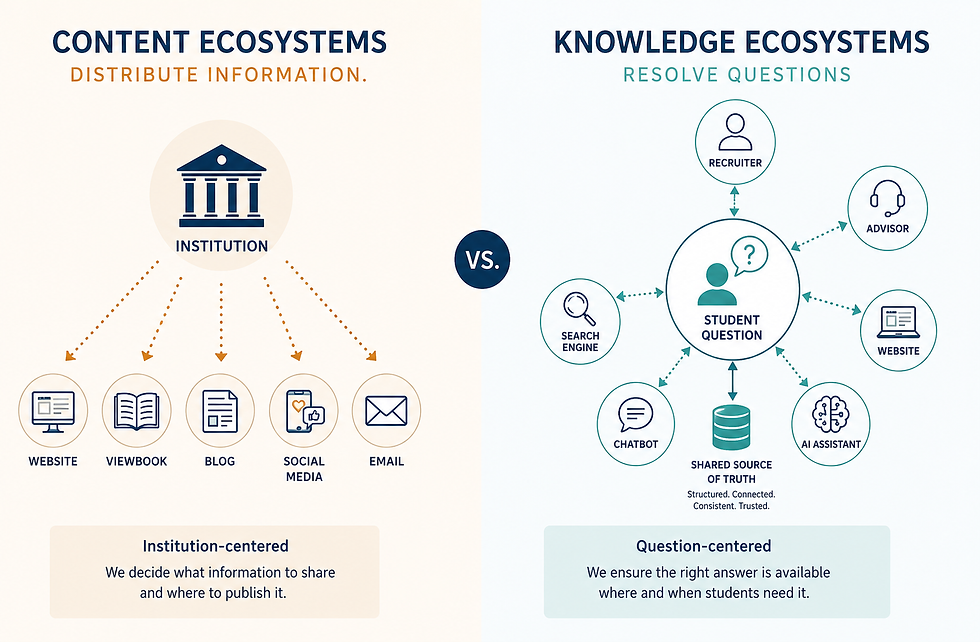
The shift toward knowledge ecosystems doesn't mean websites become less important. In many ways, they become more important, but their role may be changing.
Historically, websites were designed primarily for human navigation. We expected users to browse, search, click and explore.
Increasingly, websites are becoming knowledge repositories that feed search engines, AI tools, chatbots, digital assistants, recruiters, advisors and future technologies we haven't imagined yet.
That means institutions need to think not only about what information they publish, but how that information is structured, connected, maintained and discovered.
Schema markup, structured content, consistent terminology and strong information architecture are no longer just SEO considerations. They are increasingly part of how institutional knowledge is understood, surfaced and delivered through conversational experiences.
Because prospective students aren't going to use the same tools.
Some will ask a recruiter.
Some will use your chatbot.
Some will search Google.
Some will ask ChatGPT, Gemini, Claude or whatever comes next.
We can't control which door they walk through, but we can improve the quality, consistency and accessibility of the knowledge waiting on the other side.
The challenge is no longer whether students can find information. The challenge is whether institutions can make their knowledge available wherever students choose to look for answers.
The real challenge isn't AI. It's knowledge.
Most institutions asking questions about AI are really asking questions about technology.
Should we build a chatbot?
Should we implement AI search?
Should we use generative AI for recruitment?
Those are important questions, but I think there's a more fundamental one underneath them.
How do we ensure the right answer reaches the right person at the right time?
That's not a communications problem.
That's not an AI problem.
That's a knowledge management problem.
Before an AI can provide an answer, someone has to answer questions like:
Who owns the information?
Who validates it?
Who updates it?
Who is responsible when policies change?
Who determines which answer is correct?
Who ensures consistency across departments?
Technology can help distribute knowledge. Technology can even help maintain it.
But governance still matters. Ownership still matters. Accountability still matters.
Who owns the answer?
This is where many knowledge initiatives become difficult.
Everyone feels ownership over the information they're responsible for and they should.
Admissions should own admissions information.
Housing should own housing information.
Financial Aid should own funding information.
Academic Schools should own program information.
Subject matter expertise matters.
The challenge is that students don't experience institutions through organizational charts. They experience them through questions and those questions rarely fit neatly into departmental boundaries.
Students don't ask: "What information does Financial Aid own?"
They ask: "Can I afford this?"
They don't ask: "Which department manages residence?"
They ask: "Where am I going to live?"
Knowledge ecosystems don't require people to give up ownership of their expertise. They require organizations to think differently about how expertise is shared, maintained and governed.
Everyone contributes.
Subject matter experts validate.
Someone governs the ecosystem.
The goal isn't control, it's trust.
Knowledge ecosystems shouldn't reduce expertise. They should reduce repetition.

One of the biggest misconceptions about AI, chatbots and knowledge systems is that they're designed to replace expertise.
I think the opposite is true. The best knowledge ecosystems should make expertise more valuable.
Think about field placement coordinators. Every intake brings questions.
The information may be slightly different, the requirements may change, the student circumstances may vary. The nuance matters.
The value they provide isn't answering the same foundational questions hundreds of times. The value they provide is helping students navigate the complexities that don't fit neatly into a FAQ.
The same is true for recruiters, advisors, financial aid teams, housing teams and faculty.
The goal isn't to eliminate human interaction.
It's to reduce repetitive interaction.
Every hour a recruiter spends answering the same admission question is an hour they aren't spending helping a student choose the right program.
Every hour a placement coordinator spends rewriting the same foundational email is an hour they aren't spending supporting students through complex situations.
Every hour an advisor spends locating information that already exists is an hour they aren't spending advising.
Knowledge ecosystems shouldn't reduce expertise.
They should reduce repetition and perhaps that's one of the most practical ways organizations can begin thinking about doing less with less.
Not by reducing people.
Not by reducing service.
But by reducing the amount of repetitive work required to deliver the same information over and over again.
Where institutions can start
The good news is that building a knowledge ecosystem doesn't start with AI.
It starts with understanding your audience and your information.
A few practical places to begin:
Review your website search data. What are people actually searching for?
Ask ChatGPT, Gemini, Claude and other AI tools common questions about your institution. Are the answers accurate?
Audit the questions your recruiters, advisors, call centres, social media teams and ambassadors answer every day.
Map those questions to the student journey.
Look for conflicting answers across websites, PDFs, presentations, emails and internal resources.
Identify institutional knowledge that exists only in one person's head.
Determine where your source of truth should live and who is responsible for maintaining it.
If your website, chatbot, recruiter, advisor, ambassador and future AI assistant all answer the same question, where should that answer come from?
If you can't answer that question, that's probably where you should start.
The next challenge
I don't believe websites are disappearing.
I don't believe recruiters are being replaced.
And I don't believe AI will solve every communication challenge we face.
But I do believe expectations are changing. It's no longer enough to ask whether students can find information. We need to ask how they expect to receive it; because students aren't just navigating websites anymore, they're navigating conversations.
For years, institutions have invested in content ecosystems - websites, viewbooks,
program pages, search tools, social channels.
The next challenge may be building knowledge ecosystems. Not because AI demands it, not because chatbots are trendy, but because students increasingly expect answers instead of information and because organizations are increasingly being asked to do more with less.
The conversation that led me here started with social media restrictions and changing search behaviour.
It ended somewhere I wasn't expecting, not with a question about platforms, algorithms or AI, but with a much older question:
How do we ensure the right answer reaches the right person at the right time?
The technology may change.
The challenge remains the same.


Comments